Tuesday, January 26, 2016

Fashion Fads: A Crafter's Catch-22


I don't claim to be a fashionista, but something I have noticed over the years (as I'm sure many of you dear readers have) is that fashions come and go.  Some last a long time, while others last about as long as a snowcone in the clutches of a fire-breathing dragon in the middle of Death Valley.  

Poor Norbert.


Experienced crafters, especially those that enjoy knitting or crocheting (or otherwise handcrafting) garments intended to be worn in public, tend to be pretty keen on such matters.  As a whole we know what has lasted year after year, generation after generation, and (as long as we mind our guage, follow pattern instructions, etc.) it always seems to look classy.  Classic.  Well put together.  Cases-in-point:  Aran or Fair Isle pullovers.  
 
My favorite sweater...ever!  Every time the mercury drops, this comes out of the wardrobe.

A very cute example of Fair Isle work in the yoke... 

Occasionally, though, the pattern designers for big yarn corporations will put out patterns that gear toward the latest trends and hot-ticket items flying off the department store shelves--keeping up with the Jonses, if you will. 

Initially, this doesn't seem like a bad idea.  If you work fast enough, you can have the latest and greatest accessory, and in colors and cuts that suit you so you don't have to look like everyone else.  But that, friends, is a big "if".  Even if you've got the fastest knitting needles, crochet hook, or sewing machine in town, you might be stuck with something that is here-today-gone-tomorrow in a nearly literal sense. 

Let me tell you a story...


In my experience with what I call the "Great Poncho Craze" when I was in middle school, I saw a few of my fellow students wearing the triangular-or-diamond-shaped pieces to and from classes.  Although I somewhat hate to admit it now, I relished the idea of a poncho and I was determined to have one.  I had just learned to knit and crochet that summer, and the new pattern-a-day calendars I had gotten for Christmas were chock-full of ideas.  

A couple of examples from my youth, as patterns from the local craft store...something else from the 70s that was making a comeback nearly thirty years later:  those big jeweled flower brooches. 

I could jabber on about the long process of looking at patterns after school and the endless daydreaming about how fabulous the final result would be, but to make a long story short my coveted accessory had landed back into the fashion recycle bin before I could think to beg my mom to take me to the local Joann's (a fabric and craft chain here in the US).


Fast forward ten years, and it almost looks like they've returned in a few new incarnations:  the cape, the capelet, and the ruana. 


Ponchos and capes, reinvented.  How long will these stay, I wonder?  A capelet, FYI, is a shortened version of a cape, usually ending at the elbow of the wearer.

Now, I'm not taking a stand for or against the poncho and its cousins (although I probably would never have lived it down if I ended up with one and wore it at the time), or any big trend for that matter, but it does beg a very good question: How willing am I to invest time, money, and space in my wardrobe in something that may only last the rest of this season and may or may not return the same time next year?  And if I'm making it from scratch, will it even be finished before it lands back into the runway recycle bin? 

There is a way to side-step this crafter's Catch-22, however, and even if you don't craft but still want to have your chance to get ahold of the current "it" item, but it does require some reflection , and a few more questions to ask yourself. 

Quiz Time! 


1.  First thing you'll want to consider--and probably the most important--is if you can see yourself wearing the thing even when the trend piddles out.  If so, then go ahead!  Knock yourself out! And if fate is on your side, whatever it is might even come back around before you think it will.  And if it does, you'll be prepared.  MWAAHAAAHAAAA!!!! 

If it doesn't come back so quickly (or at all), then you'll still look pretty cool; it shows that you know what suits you, and you don't care what the rest of the world thinks.

2.  If in response to number one you think, "I really like (insert name of item here), but I don't think I'd want to be the only one wearing it if it goes off the mainstream," then you might like something that can be restyled, or worn in varying creative ways. 

For instance, going back to the whole ruana/mega-wrap thing (because I'm pretty gosh-darned out of the loop when it comes to what's new), if you opt for a shawl instead you can have the freedom of enjoying it as a big luxurious wrap, but it can easily convert into a kicky scarf.  
Shawls are pretty awesome.  Wear it around your shoulders, or around your neck--it looks especially cool under a denim jacket!  (and yes, those are my own drawings.)

Granted, that one is geared more toward the makers in the group. 

For those who are more inclined to go store-bought however, that's not so easy unless you know someone handy with a sewing machine and willing to help (especially if a good bribe is involved).  If you're neither a maker nor know anybody who is, please move forward to number 3. 

3.  For argument's sake, let's say number two is more where you stand.  Unfortunately, your "it-thing-in-question" may not be something that can be restyled or worn in a slightly different way (because hey, a skirt is a skirt, and--unless you know some magical shoemaking elves or are one yourself--those platform shoes are staying just as they are).  This is when you'll need to ask yourself how much you're willing to spend and whether or not you're willing to let the item take up physical space in your wardrobe.  For the makers reading this, you'll also want to extend this and ask yourself how much are you willing to invest in the time and materials required to construct our "it thing".  Putting in the time is a biggie; I've seen and made some of those "quickie knits", where the pattern spouts claims of a cool new look in under three hours.  And trust me--they look like they were done in under three hours, and that's not a good thing. 

In the end of it all...

I hope this shed some light on how to survive the fads, from the resplendent to the ridiculous and somewhere in-between, that ebb and flow like the tides.  Some ideas will be a flash in the pan, others will grow and evolve, but like it or not, fads will always be the latest rage! 

Saturday, January 2, 2016

For Auld Lang Syne

Happy New Year, dear readers! 

I hope the holidays have treated you well; a lot has happened in the time that's gone by. 

My Christmas and New Year have been fantastic; I've been working a retail position (and I simply love the people I work with!), I finished my Christmas knitting with time to spare, and I've been able to catch up with family and friends along the way. 

Going On Safari

Two Fridays ago (the week before Christmas), I took a very dear college friend to the San Diego Zoo's Safari Park.  If there ever was a perfect day to go, this was it!  The weather was perfect--sunny and just warm enough for jeans, a t-shirt, and a light jacket--there was hardly anyone else there, all the animals were out and active, and we saw nearly everything there was to see (except the Garden Walk and Hidden Jungle, but there's always next time). 

We arrived a little before 11, and stayed until closing--a very long day indeed!  As much as I would like to talk and talk on and on about everything we saw and did, I think the photos speak for themselves. 

Me and Noelle. 
When you go to the Safari Park, taking a picture on their big bronze rhino statue is mandatory.


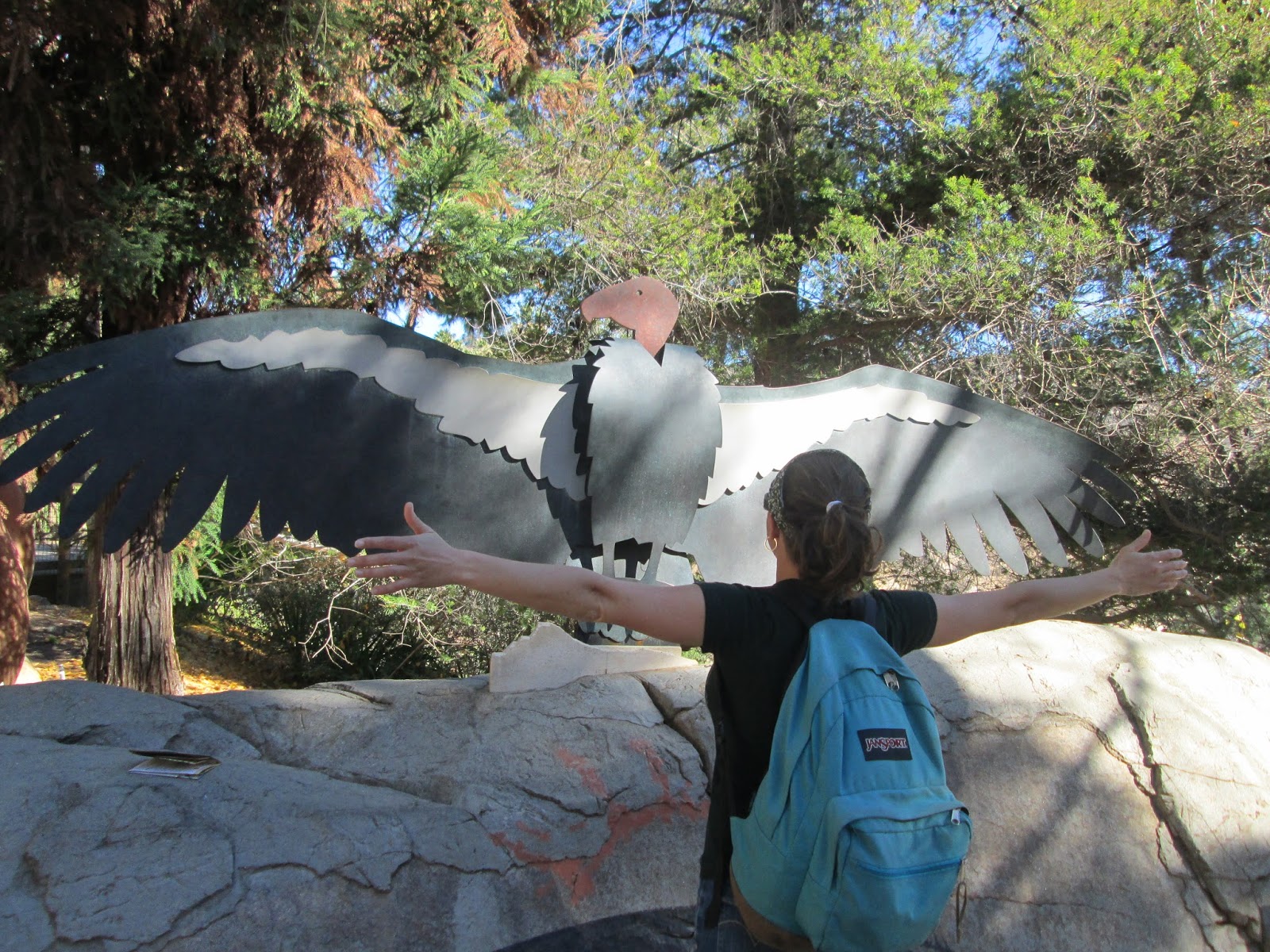
How do you measure up to a California Condor?

 Tiger Trail

Tyger tyger, burning bright, / in the forests of the night...
--William Blake, "The Tyger"
One of the Park's female Sumatran Tigers

Introducing the newest member of the tiger family...

...Here's Suka!  Find out more about him here on the Safari Park's official site.

What a handsome face!

 Lorikeet Landing

What these comical little birds lack in size, they make up for in color, personality, and most of all vocal ability.
One little Lorie...

...two little Lories...

...and three!  Yummy, yummy nectar!

 African Woods, Walk, and Tram

The African mammals really are a diverse group, and absolutely incredible!  It is genuinely hard to have only one favorite animal here. 
The elusive Okapi...

...and its more familiar cousin, the giraffe.

Those babies grow up so fast!

One of the four lion cubs born in June 2014...this little lady still has some spots on her hip.

One of the cheetahs, as seen from the tram.  We also saw the Cheetah Run, which goes on at 3:30 p.m.  Get there early if you want a decent view.
A crash of beautiful Southern White Rhinos.  If you don't know already, I have a very big soft spot for these animals.

 
 We didn't take pictures of everything we saw; sometimes it's better to just absorb what you can, when you can, and without a screen in front of you. 
And just a quick plug, I encourage you dear readers to log onto the San Diego Zoo's and Safari Park's websites to plan an amazing safari, to learn about the incredible animals at both locations, and to find out what you can do to save them from extinction. 


Projects Completed! 

Since I finally finished my Christmas knitting and the finished objects have been revealed to their lucky recipient, I can finally give the big reveal to you the readers, and take my other current projects out of hibernation. 

Here's my variation on the Neon Ski Bonnet, by Lacey Volk (links to Ms. Volk's Ravelry page, with the original Neon Ski Bonnet pattern, and blog). 

The only thing I changed when making my incarnation of the hat was the design in the center of the band, which I changed to a three-strand braid.
I selected "I Love That Yarn" in the antique teal colorway--it's easy to care for, and the feel in the hand and around the head is a dream! 

I also made an infinity scarf to go with the hat, knitting a variation on Phyll Lagerman's Lasagna scarf (Phyll's Ravelry page) in a 1-by-1 seed stitch instead of 1-by-1 rib, and worked in Yarn Bee Andes Alpaca, a heavenly 30%/70% alpaca/acrylic blend, in the colorway Paradise.  I liked that it was reversible, but I desired something a bit wider than the ribbing.

Unfortunately, I was a complete dunce and forgot to take a picture of the finished object. 

I had an absolute blast making both of these projects, and I might need to make another of each once the rest of my projects are back in order. 

A Wonderful Christmas

Christmas certainly came and went quickly, which seems to happen more often as we grow up.  It doesn't exactly help when stores start putting up trees and ornaments and snowmen while the rest of the world is trying to figure out what they're doing for Halloween.  But that's enough of that. 

Amid working retail, I had time to spend with family and friends.
I baked Christmas cookies with my mom (actually, she did most of it during my shifts at work). 

We set up the tree and decorated it. 
The tree on Christmas morning...true, it's a blurry one, but it still captures the spirit!

We hosted an ornament exchange with our pals from work. 

My dad and I made our traditional pre-Christmas-Starbucks-run-and-mall-walk-around. 

On Christmas Eve, the three of us went to the 10 p.m. mass and watched the first 15 minutes of Elf when we got back home. 

Most people in climates that allow it expect a white Christmas, where everything is silver and sparkling.  Living in the low-elevation regions of Southern California, that's not going to happen.  My favorite Christmases have been the ones where the garden is laced with a delicate covering of frost, or like this year, where it had rained the night before and the ground is wet and washed and clean and the blue morning sky is filled with big puffs of clouds. 

I received a lot of wonderful things this year, including a beautiful, hand-carved St. Nicolas figurine my aunt found in Montenegro...
...a handmade yarn bowl my mom found for me on her trip to Portland with her friends...

...and a wonderful Shutterfly photo book my mom made, with photographs from my years at Cal Poly San Luis Obispo.

 Opening presents is always interesting with a frisky beagle; Linus is always trying to get our attention, even if he has to snag one of our presents and make us chase him for it.  Possibly even more fun than opening the presents themselves is wadding up the wrapping paper and watching him chase it around the Christmas tree! 

 Every year we give him a new toy, usually the hard plastic type (the soft fabric ones don't last long with him).  Normally he takes to it right away and starts chewing with glee and gusto.  This year, however, we thought it would be fun to give him some of those food-scented ones.  He promptly wanted to bury the darn things. 

He gave up after a while.


My uncle  and cousins came in the afternoon, and we spent it eating cookies, playing Scattergories and Bananagrams, and having an overall wonderful time! 

Except for looking up words for challenging each other during the games, and taking pictures in front of the Christmas tree, nobody was behind a phone screen. 

Nobody was texting.

Nobody was playing with an app of any kind. 

The television was turned off, and there was music in its place.

It meant the world and more to me. 


It seems like Christmas flies by too quickly, especially in these modern times.  I think old Scrooge's nephew Freddy sums up the season very well indeed:
"But I am sure I have always thought of Christmas time, when it has come round—apart from the veneration due to its sacred name and origin, if anything belonging to it can be apart from that—as a good time; a kind, forgiving, charitable, pleasant time; the only time I know of, in the long calendar of the year, when men and women seem by one consent to open their shut-up hearts freely, and to think of people below them as if they really were fellow-passengers to the grave, and not another race of creatures bound on other journeys.  And therefore... I believe that it has done me good, and will do me good; and I say, God bless it!”--Fred, A Christmas Carol  (Charles Dickens)

 Ringing in the New Year

Generally speaking, our New Year's celebrations are pretty mild; we like to stay off the road, and I'm usually the only one who has the stamina to stay up until midnight.  But we love playing games--usually Sorry! or Scrabble--and the competition is fierce.  Sorry! is my Dad's game, but Scrabble is my territory, and I rule. 

We may miss the ball drop, and we often sleep through the entry of the new year, but one thing I never miss on New Year's day is watching the Tournament of Roses Parade, and seeing the Cal Poly Universities float is the highlight every time.   

For those of you who missed it, this year's entry was pretty darned cute! 


I have had other favorite floats from years' past, though, and you can check them out in the link in the caption.  While you're browsing, look for Soaring Stories (from last year--absolutely spectacular!), Tuxedo Air from 2013, and Jungle Cuts from 2010.  As an alumnus of Cal Poly San Luis Obispo, I take great pride in seeing my alma mater represented, and my goal is to be a volunteer for float decoration.
 

Resolutions, resolutions. 

Just like many others of us, I've made a pretty comprehensive list of New Year's resolutions.  There's a lot in my life that I would like to start doing, change, or rearrange; whether or not I actually follow through could be a different story.  But if you'll allow me, I would like to share a few of mine here. 
  • Read more, and watch less television.  Save the good programs for when they're airing, but turn off the midday, mindless background stuff. 
  • Learn a new word every day.  Or two, if possible.  I'm planning on getting a word-of-the-day calendar to help with that. 
  • Eat more fruits and vegetables every day. 
  • Learn to cook. 
  • Go for a run, at least every other day, and fill in the alternating days with strength training or yoga. 
  • Keep a daily journal. 
  • Learn to play the harp, the guitar, and re-learn the piano.  I have all these beautiful instruments longing to be touched and played once more. 
  • Finish projects that I start--no more paintings or knits going into extended and excessive hibernation because I get bored or stumped. 
  • Land a regular job with benefits.  Start by applying for anything and everything I can possibly think of. 
  • Pray more.  I notice I worry far too much about things that are out of my control, so I need to put my faith back into God and let Him take control when I've done all I can. 
  • Play outside.  I have my mom's beautiful garden, and a great little buddy to enjoy it with, and I need to do so while I still can. 
If I haven't lost you at this point, I would love to hear your resolutions and plans for this year. 
 
Until next time, love and joy come to you, and to you your good health, too, and God bless you and send you a happy new year! (paraphrased from Here We Come A-Caroling, 19th Cent. English)

Monday, December 14, 2015

Keeping Tabs on the Stash


Howdy, everyone!

This would normally be the time I would go over my current projects, give progress updates, etc. 

However, since my current projects are actually Christmas gifts for others (NO SPOILERS!), and the projects I’ve previously posted are in a temporary state of hibernation to meet holiday deadlines, I thought I’d put in my two-cents-worth on a topic that most knitters and crocheters have to some extent; some of us are happy to discuss with our fellow fiber artists, but non-crafters just don’t understand it. 

I’m talking about the stash.  That ever-growing collection of yarn, needles or hooks, and—for spinners like me—fiber that’s ready to be spun. 

I’ll be the first to say, mine can still considered by some standards a “baby stash”.

It just barely spills out of the bin, even when haphazardly jumbled in,

Really, this thing is only a foot-and-a-half deep.  And it's not as organized as it could be.  That's about to change...
 

And it only takes up about 12 square feet of space on my kitchen counter. 


But what it lacks in size it makes up for in personality, and believe it or not, a person’s stash can say a lot about the owner, as I think mine does.  Let’s take a look at what’s going on…

UFO’s


No, I’m not talking about alien spacecrafts—in this case, UFO stands for Un-Finished Object.
Not pictured:  the beginnings of a shawl in light blue and sage green laceweight


Some yarn I buy with the intent of making a pattern, or at the very least with a general idea of what kind of thing I want to make.  But for whatever reason, I start projects more than I finish them. 

What it says about me:  I dig variety.  And If I get stumped on a technique or ideas for finishing, I don’t stew too long over it.  I’m also easily distracted. 


The Crowd of Novelty Yarns

Finally, after five-plus years at the bottom of the stash, they see daylight.  And I actually have some idea of what to do with it! 

Eyelash and fun fur and bobbles, oh my!  
All wound up, they look like tribbles that made trouble in a painter's studio.  And if you're not careful, they can reproduce like the darned things.  Yeah, we've all seen this trend come and go, and like all trends they can bring either fond nostalgia, cringe-worthy flashbacks, or something in-between.  Used well, they can add a little something extra to a scarf or some socks.  Used wrong, though, and results vary from Muppet with a shedding problem to goodness knows how much worse. (Ravelry users, check out the Ugliest FO thread under “For the Love of Ravelry” if you haven’t already become addicted as I have)  Some of these were either purchased for me when I was a young knitter just starting out, or I bought them on an impulse and later regretted it.  But I can’t bring myself to get rid of them. 

What it says about me:  I don’t like wasting yarn, and I will find at least some kind of fun, updated use for an out-of-date novelty. 

 Re-worked Garments and Commercial Yarns

I was considering using the sweater on the left in a crazy-cat-lady costume for Halloween, but even that was too outlandish for me. 


There are times when I have a love-hate relationship with a store bought piece in my wardrobe; I just don’t like the thing itself, but I love the material too much to get rid of the garment in its entirety.  This is where knowledge in the skill of deconstruction comes in handy.  If you know where to take out the seams and how to do it, and you know which tail of the yarn to pull, you’ve got a new sweater, shawl, or other ready to be made.  The same can go for some plain, no-frills yarn, preferably something that has visible singles plied together.  Before you know it, you can split 300 yards of worsted into 600 yards of DK or sock weight.

What it says about me:  at least one of the following... 

·       I’m resourceful

·       I’m not well-funded to buy the 1,000 or so yards required for a sweater

·       I’m freakishly patient

·       I probably have waaaay too much time on my hands, or

·       Most likely a combination of all of the above. 


The Bag of Odds and Ends


Oh, boy.  If ever the phrase “not enough to keep, too much to throw out” applied.  In here go all the bits of dreamily-colored discontinued nylon so soft you’d swear it was genuine alpaca, or some extra chenille you didn’t know you even had when you were making an infinity scarf from another ball of the same yarn.  Anything you like, that’s discontinued, or think you could use for something.  I keep all of mine in a gallon-sized zip top bag, along the side or back wall of my stash bin. 

What it says about me:  Besides being a pack-rat, I really don’t know. 


Do you have a stash?  Do you think it reveals anything about you?

Sunday, December 6, 2015

Fear Factor: Crafter's Edition (part 2)

 
For the longest time, I have been simultaneously in wonder and in fear of cable work; at the stores during the cooler months, I gravitate toward sweaters elegantly striped with four-by-four ribbing with that bold licorice-like twist spaced evenly down the vertical line of the garment.  And don't get me started on the Aran style jumpers--thick, cozy, and adorned with panels of braids, basketweaves, and trellises.  My favorites look like they belong in an ancient Celtic stone carving. 

But when it came to actually knitting such pieces, even as a foolhardy knitter who wasn't afraid to use a different yarn than a pattern called for and not bother to check my gauge (I have since learned my lesson--especially with the gauge.) I would shy away sheepishly from any pattern that required cables. 

Maybe it was the confounding charts?  Or the freaky-looking needles said to be required?  Or the mystery of how on earth do you get the yarn to contort like that?  Nonetheless, I was content to simply admire the pretty pictures and scour the shops to find a ready-to-wear piece that suited my particular aesthetic tastes. 

It took until last spring for me to actually get up the nerve to stop looking and start doing.  I had just finished a scarf with plenty of the main-color yarn to spare, and the urge to start a new project to use it up.  I eventually saw the Celtic Cables Dishcloth pattern on Yarnspirations (if you would like, this is the Ravelry link to add to your queue or favorites!).  The Saxon braid spoke to me, and the enticingly simple-looking cables along the edge whispered, " Don't be scared!  You can do it!" 

Before I could think twice, I had cast on and started on my first cable adventure.  Here is the result of my efforts:  

I continued the repetitions of the pattern to elongate the dishcloth into a simple pouch, complete with some spare, and might I add cheesy, buttons I had acquired.  
The yarn had felted itself slightly from previous moments of indecision before the cables found me, and a little from slip-ups along the way, but that weeklong adventure in cables had empowered me.  I could knit anything I wanted to. 

Here's what I had found on my journey, and some of my insights for others with untapped cabling potential. 

Charts

If you haven't already, please read my little bit on charts from my inaugural Fear Factor: Crafters' Edition post.

Read it?  Got the hang of it?  Awesome! 

Wrong-side rows

Just like when you read a lace chart, or any chart for that matter, you read the right-side rows from right to left, and the wrong-side rows left to right.  Unlike lace, though, for the most part you're just working with knit and purl stitches.  That being said, unless you're knitting a pattern that results in reversible fabric, you don't always have to look at the chart when you're working the wrong-side rows--I love that! 

So, how do you know what to do?  With each stitch or set of stitches, you just look at those that line up with them from the previous row.   (Insert picture and caption)

Right-side rows

Under normal cabling circumstances, the right-side rows are going to be the ones where you're going to cable.  And you're going to need to know when.  The symbols used in cable charts are a little more...well, dizzying than those in lace charts.  They span multiple stitches, and they often travel, if that's not daunting enough. 

I sense some hyperventilation, so let's take a deep breath and dissect a chart.  But before we can dissect anything, we need to see the specimen intact. 

One of my favorites; not only is it pretty, it gives a sample of different techniques. And yes, I realize the error in row 11--It's supposed to be the same as row 3. 
Before we continue, I would like to mention that other pattern writers may have some slightly different insignia or different abbreviations, but they all come down to the same thing. 

Let's break it down, shall we? 

Name:  Cable 4. 
Alias:  2-over-2
 This is one of the most basic cable stitches, done two ways.  It's called the "cable 4" because there are four stitches involved in the maneuver.  The reason for the other name:  two stitches are cabled over the other two, depending on the instructions.  In the C4L, the top stitches travel to the left, as above, and the C4R to the right.  Line up a bunch of the same type in a column, separated with four rows of stockinet in between, and you'll have a classic cable: 

You could so the very same thing with only two stitches in the sequence. 

Don't worry; once we go over the rest of the stitches, I'll show you just how it's done. 

Also, if you recall the lace charts from before, you'll see those little boxes with either dots or blank spaces that indicate purl and knit stitches, respectively.

This is important, and it will make or break your pattern.  Pay attention to where they are in the pattern in general, and where they are inside the cable sequence, as below: 

I know, my handwriting stinks using a tablet. 
Stitch name:  Turn 3. 
Alias:  Turn 2-over-1


These two are known as "turns" or "traveling stitches".  This is when two knit stitches are cabled over purl stitches.  In a T3 like this, it's always two knit stitches crossing over one purl stitch. 

As with all of these examples, there are multiple variations on this stitch, and one stitch can have as many aliases and guises as the main character in one of those secret agent movies.  Just read the instructions for your pattern, and it will become clear. 

And now, we knit.

So let's, in the words of Larry the Cable Guy, "get 'er doooone."

(oh, yeah.  I went there.)

Equipment

Contrary to popular belief, you actually can knit cables without a cable needle. 

If you're like me and you crochet and have a handy supply of crochet hooks in all different sizes, you're all set.  Just match the needles in your project to the closest size crochet hook you have.  If you don't have exactly the right size, it's better to err on the small side than the large size. 

No crochet hooks?  Use a double-pointed needle (known simply as DPNs), again, erring on the small side. 

No crochet hooks or DPNs?  No problem.  Go with a paperclip or a safety pin.  Or clean chopsticks.   Anything you have that can hold those live stitches, because we will be taking them off the working needles.

 If you have a high level of dexterity or are double-jointed, you can even pinch the stitches when you rearrange them.  (Only if you are very careful and very adventurous with a side of reckless do I recommend simply pushing the stitches off the needle and leaving them hanging.) 

Moving stitches. 

I've stalled for you long enough.  It's time to cable.  While my favorite is the crochet-hook-method, I will be employing the safety-pin technique since that's the easiest to photograph. 

Let's start with the very beginning of the chart:  that first C4L, after the two purl stitches. 

After you work those two purl stitches, slip the next two stitches onto your crochet hook, cable needle, or safety pin (whichever you choose to use) and remove them from the left-hand needle. 


Move them to the front of your work--remember, we knit right-to-left, and this is a left-leaning cable--and knit the next two stitches. 

Finally, move the two stitches back onto the left-hand needle and knit as usual.  This is where I'd like to point out the advantage of a crochet hook:  you can knit directly off your hook and onto your right-hand needle. 

Since the rest of the row is just basic stitches, it's onto the next row. 


When working wrong-side rows, I just take a cue from what happened on the previous row.  For instance, the very first and very last stitches are purled on the right side, so we're going to knit when working the wrong side.

Then just follow the rest of the stitches. 


Time for the next row of cabling.  Work the first stitch of the chart, and then get ready for the turn.  Since this is a T3R, the next stitch (with the safety pin) will be moved to the back. 


Since this is a 2-over-one, knit the next two, move the purl stitch back to the left needle, and purl.  In this pattern, knit the next two stitches, and repeat the turn. 

So why is this a turn and not a cable when it's practically the same move? 

Excellent question! 

In cables, you're twisting two stitches or sets of stitches of the same type, just like braiding hair or something else.  When you're turning, you're moving that "strand," so to speak, across a background. 

I hope that answer/explanation makes sense. 

Got the turn?  Nice!  Now finish that row, work on your wrong-side row, and let's continue. 

In row 5, we have a purl, two knits, another purl, and another 2-over-two cable (or C4, whichever you want to call it), this time going to the right.  It's just the same as the C4L, but this time the first two stitches will go behind your work after slipping them onto the cable needle and working the next two. 

Rows 7 and 8 will conclude the first set of the pattern, with 7 containing two T3L (2-over-2, left) stitches.  Again, it's just like the T3R, but the two knit stitches are being moved to the front while the purl stitch is worked. 

What the T3L looks like, this time using the crochet hook (my preferred method).

There!  That wasn't sop hard, was it?
Here's what the chart makes after several repeats: 

If you liked this, check out Ravelry, Knitty, or some of your favorite sites for more patterns.  Still have questions?  Feel free to leave a comment! 

Once you've gotten the basics, there's really no limit on what you can do.  Sometime, I think I'll even make one of these...

Remember, if you have a suggestion for another Fear Factor:  Crafters' Edition post, don't hesitate to leave a comment or a message.

Until next time, have fun and keep making awesome things!